Monday, December 5, 2022

Am I Doing it Wrong? ...

Over recent years there has been a growing call for more diversity in our children's literature, and rightly so. Our literature should reflect the people who make up our society with more representation of different cultures, ethnicities, abilities/disabilities, sexual orientation and gender. I have wrestled with what I can and can't write about myself, growing in my understanding of what my limits are and ceding space (if it is in my power to do so) to those who will do a far better job than me. 

Back in 2016 a picture book of mine was called out for having a male main character in an article discussing a lack of female representation. I confess the rebuke stung but it did its job because I became much more aware of who I was writing into my stories. But I have discovered over the years that there is a flaw in my gender representation plan. Readers/reviewers/folk-in-general DO NOT NOTICE. They decide and then that is the gender of the character. They ignore my clues ('he said', or 'she said' or a complete lack of identifying pronouns).

Where I have avoided pronouns to enable the reader to make their own decisions I guess it might be fair enough that the reviewer/discusser has decided for themselves to apply a label, although ideally they would also take the route of making it vague - it's for the target audience to decide, not the reviewer or other adult intermediary.

My dilemma I guess is that I am wondering if my efforts are having the desired effect; am I managing to reach the people for whom this really matters (the kids are alright and we just need the grown-ups to catch up)? I suppose my books aren't centering the gender discussion so this might contribute to the assumptions being made, but I make deliberate decisions about my characters when I am crafting my stories and I am perplexed when these get no cut through. Sometimes my decisions are about ensuring there is an even mix of genders in the story, sometimes it is about challenging our expectations of roles and who performs/inhabits them, and sometimes it is just a practical decision - in BatKiwi for example male kiwis are smaller and female bats are bigger so the female bat has more chance of carrying the male kiwi (although actual physics/reality makes it impossible sadly), however I also didn't want a male bat swooping in to save the day for the female kiwi. 

When I review or talk about books other than my own I try to do my due diligence (although I am likely to have got it wrong sometimes in the past too). Novels are easier in some respects because character names and context can be obvious signifiers (although not always), but in a picture book it is a simple task to check. This isn't all about me and maybe these reactions don't matter but gender representation is important and I am just wondering - are the choices I'm making working like I hope they will? Are these responses just an anomaly or are they something to be addressed?

Sunday, November 27, 2022

When the post is more of a poem ...

Walking in Circles

This is a weird time of year. There are still things to be done. Little jobs to be finished. All the things you kept putting off which can be avoided no longer. And you never stop turning ideas over in your mind and trying to push them out into the sunlight like little paper boats. But things are also winding up. Folk are hurrying to get work completed as quickly as possible because there are festive preparations to be made and end of year functions to attend and holidays to be anticipated. And then there will be the complete silence of empty offices for a month. It is my annual limbo. It is my fever dream when I fantasise about who might invite me to talk at their event in the coming year and do they live in another country. I imagine chatting on stage with an interviewer like the grown ups do. I plan my response to an eager media keen to talk about my latest titles: where they sprung from, why I write them, what motivates me, what I worry about at night. And then late January I will wake up and go about my usual business. I have been wondering about reinventing myself. Perhaps it is already happening. Certainly writing poetry is a sort of new path. It might have started in a limbo time fever dream years ago. Maybe I am just walking in a circle and I will come back to the beginning again. Like when you are lost but not really. I am taking the appropriate steps ... perhaps next year will be different after all.


Friday, November 4, 2022

I'm back...

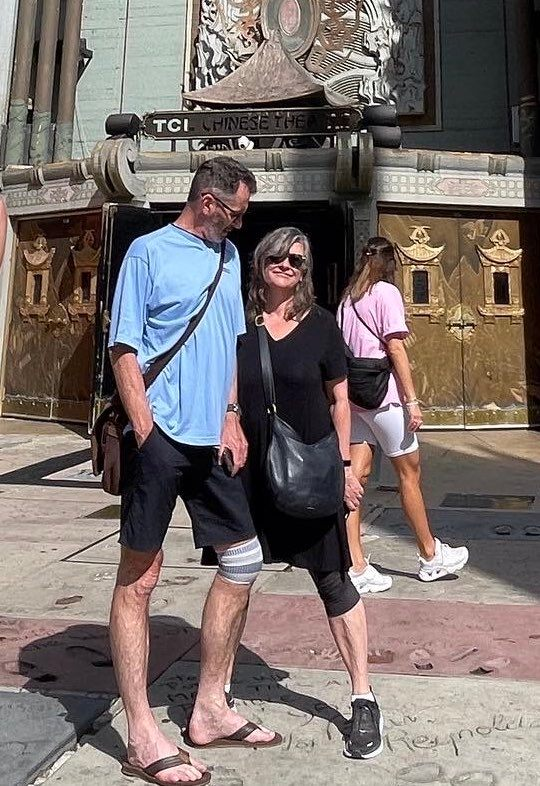
Hi there folks (waves) - I apologise for the prolonged absence. I had very good intentions of posting before I went away on October 1st but you know what they say about good intentions. Things got busy with preparations and work needing completion before departure and then suddenly it was time to go. Back now. We were away for nearly a month visiting our daughters and having a bit of an adventure. It was travel of the good brain-fillery sort. We hung out in the Californian desert (do NOT touch the Joshua Trees) and wandered around Hollywood. We went to the theatre in the Westend, took in a feminist art exhibition at the Barbican, explored castles, ruins and ruined castles. We checked out the roman baths at Bath, several henges (Avebury and Stone) and the pier at Brighton. I think the creative well is well and truly filled.


Here we are outside Grauman's Theatre in Hollywood 

Travelling is an odd sensation when you are creatively inclined though. The creative brain is always at work so it's hard to leave the job at the office. A lack of pause in the proceedings of travel usually means that I don't get the chance to sit and write while away but exploring poetry over the last wee while changed that this time. Things I saw and heard on our journey inspired me and I jotted down several poems. I also made a start on a small new project I was given not long before we went away. It was so good to be able to scratch the creative itch without compromising the trip.

What has truly surprised me is that while away and since I got back, I have written some rhyming children's poems. And they have turned out well (not just my opinion). I mean, who even am I? I have always felt that rhyming was beyond my reach but it feels like I just might have my finger tips on it now. It might turn out to be a brief relationship but I am optimistic I might be able to take a few more turns around the literary garden with this particular art form. I shall keep you posted and maybe share one of them soon. I guess it goes to show you never stop learning and developing. I think the trick for me was that I didn't look at it directly - I just let it play in some unobserved corner of my brain where it felt no pressure and it figured things out all by itself. Never say never ...

I was thrilled to see that Storylines has named our new BatKiwi book There Are No Moa, e Hoa (illustrated by Isobel Joy Te Aho-White, pubbed by Scholastic NZ) as a Storylines Notable Book for 2022. You can read all about this year's Notable Books here. This picture book, in both English and Te Reo Māori, was scheduled to be released November 1st but is unfortunately delayed. I so hope it is not stuck in the shipping doldrums for too long. Pre-Christmas is a great time for a book to step out for the first time and I have everything crossed it is here in time to wear a little tinsel, hum a little carol or two and win over some gift shoppers. As soon as it makes it ashore I will be introducing you to this fun story. Talk soon!

Wednesday, September 7, 2022

Cooking the books...

 I've been watching Masterchef Australia 2022 Fans vs Faves. I'm playing catch up with the scheduled programming but I'm now up to the last few episodes; the sharp end, if you will. I like watching programmes that feature creativity, especially competitive, challenge-based creativity. Even though this isn't how I create. It interests me how the competitors respond to critique and advice, and the things/the thought processes that underlie their creations. Clearly technique is crucial. If you don't know the steps to take to make a certain element then you just can't produce it.  Although a strange ingredient a cook has never used before isn't a deal breaker. How does it taste? What is the texture and do the qualities or components mean it will cook like a starchy vegetable or a low fat protein? If you know the rules, the science of cooking, you can make educated guesses/decisions about how to treat anything new.  Invention comes with making unexpected pairings, whether its savoury and sweet, or using foreign ingredients in local dishes. Or elevating something familiar. How do you update a classic? In the end though it's about making something people enjoy eating. Technique and quality ingredients aren't enough if the resulting flavour isn't enjoyable and the balance is out.

In the episode I watched today one of the contestants, now in the final four (from a starting group of twenty four) said he'd felt insecure about his cooking ambitions amongst his fire fighter workmates in the firehouse. Coming to the Masterchef kitchen had changed him irrevocably. There he'd met others who felt as passionately about food as he did. As inspired and excited about what was possible. Finally he'd met his tribe, and his skills and ideas and thinking about food came on in leaps and bounds and from a rudimentary understanding of food he now found himself in the top four. Using techniques, ingredients and combinations he would never have imagined using before he joined. Interacting with your peers and/or your heroes will challenge your thinking about your craft. It will encourage you and inspire you. It will introduce you to new things and broaden your outlook. Hanging out with other folk who also feel passionate about their craft is good for you. It's good for them too.  

And watching Masterchef can be good for your writing

Saturday, July 23, 2022

There are No Moa, e hoa ...

 I was so excited a few days ago to see the final internals and covers for my next picture book There are No Moa e hoa/ Kua Kore he Moa, e hoa (Scholastic, Māori translation by Pānia Papa) coming out this November. Just as with BatKiwi/ Ko PekaKiwi, Isobel Joy Te Aho-White has done a wonderful job with the illustrations, and I am so happy to say she will also be illustrating my next book with Scholastic, Sun Shower, coming out in 2023. 


I am a little obsessed with the cute little Tuatara at the centre of this sequel to BatKiwi, and she is so beautifully captured in the artwork. I can't wait for you to meet her. The colours are lush and cool, and there are many extra details across the pages for all those observant wee readers, and a few laughs for the grown ups. 

Last weekend I took part in the 2022 Storylines Hui for Children's Writers and Illustrators and I came away feeling energised and uplifted. I didn't realise how much I'd been missing the opportunity to meet and chat with my tribe in person and it was marvelous. No one understands the trials and tribulations of being a children's writer better than another children's writer. I pitched some picture book manuscripts to a publisher I have never worked with before. The Pitch Slams at the Auckland Hui are always a fast and furious event - just 3 to 4 minutes to get your summary across, but that can be enough. There were lots of authors and illustrators pitching and I really hope some contracts get signed as a result. 

There were some wonderful keynote speeches, panel talks and workshops, and underlying it all a love of the transformative power of words and the importance of story and books to help, nurture and grow young people. Despite the challenges of the last few years everyone's passion for books was un-waning and after immersing myself in this all weekend I felt encouraged, supported and inspired.

August looms and its going to be a busy month. I have a poem coming out in takahē 105 which makes me very happy. I am still finding my way with poetry so an acceptance is hugely encouragingI am taking a half day workshop on writing short stories for young people on Sunday 7th August - you can check out details here. I will be away in Southland with the Storylines Tour crew in the middle of the month - Invercargill here we come!! The week before I'll be attending the NZ Children's and Young Adults Book Awards in Wellington, and towards the end of the month I will be running my Writing Picture Books full day workshop on Saturday 27th August (details here) and reading BatKiwi (and maybe There are No Moa, e hoa too!!) on Sunday 28th at the Auckland Writers Festival. Maybe I will see you there! In September I will be having a long lie in and we have a bit of a holiday planned for October. And then it will be November already and time for a book launch!!


Monday, June 20, 2022

Writing the dreaded synopsis ...

I thought it might be useful to talk about how to write a synopsis. Or how I think they should be written anyway. I've read quite a few in my time and they have demonstrated that many people don't really know how they are meant to work. 

Having a synopsis for your book is very handy. It is a tool you can use for a variety of purposes. A good synopsis written before you get started can help you complete the writing of your manuscript. And a synopsis is not set in stone. It is not the bible on which you have sworn the lives of your children. If your story changes you can adjust it accordingly. And once the manuscript is done you can use the synopsis to help pitch/talk about your story, find a publisher and promote your story. If nothing else it is a handy dandy summary of your story that demonstrates to yourself and others that you have an appropriate structure, that there is a coherent plot, underlying themes, that your key characters have realistic motivations and challenges, and that you have a satisfying ending. Writing a synopsis can show you where there might be gaps or problems with your plot so you can go back and fix them before you submit your manuscript to a publisher. 

A synopsis needs to summarise your story. Ideally it also conveys something of the voice and tone of your work. 

Follow the direction of the story in the order in which you have written it and summarise it as neatly as you can. Each chapter might become one to three sentences? A synopsis should also help the editor/publisher/judge answer a series of questions. What kind of story is it? (Horror, lit fic, crime, romance, magic realism, sci fi etc...) Who is/are your main character(s) and where is the story set? What is the problem to be solved, the goal to be achieved by the main character(s) or the great question at the heart of the story? And what is at stake if they don't solve or achieve or answer it? What steps do(es) the main character(s) take to solve or achieve their problem/goal and what stands in their way. What do they obtain and/or learn along the way and which key folk assist them? How is the problem solved or the goal achieved or the question answered? To what do our hero(es) return? Does your synopsis do this?

You should include the ending of your story. It might feel like a spoiler but an editor/publisher wants to see at first glance that your story is a cohesive whole with a satisfying denouement. You might want to save the 'ending' for when they read the manuscript but they may not read the manuscript if they think the novel is without a good ending. Reading a full manuscript is a big investment of time.  When I see a synopsis with the ending/conclusion/solution left off I wonder if the author is hedging their bets, or hasn't been sure which way to go or has been unable to end their story. If it's just that they don't know how to write a synopsis, a publisher won't know this. And they might assume the former is true.
 
You don't want background or why you wrote your story in your synopsis. The synopsis is a summary of your story, in the style in which you have written it. Nothing more and nothing less. You need enough detail so the summary makes sense, but not so much that it ends up looking more like your manuscript than a brief run down of events. Some publishing houses want your summary to be 300 words or less. Others are happy with two pages (or sometimes more). If they want a synopsis included with your submission they will tell you what form it needs to take. Summarise your story and include the flavour of your telling of it. That is all. 

Wednesday, June 1, 2022

A little something for you ...

I am busy with other things - working on some poetry for submission, preparing content for some talks and workshops I'm doing soon, and I'm on a selection panel reading over 84 submissions, so in the meantime here is something I prepared earlier for your reading enjoyment - a short story, Rich Pickings, from my collection Time Machine and Other Stories (Ahoy! [Cuba Press], 2019). And there are teaching notes on this story (page 11) here.


Rich Pickings 

You might think it strange, how no one noticed. Although a few centimetres a day isn’t that obvious, at least to begin with. I mean, bamboo grows heaps faster – over 30 centimetres a day in the right conditions. But this wasn’t bamboo.

It was Jess that first spotted what was happening.

“Has someone been watering the cactus in the hallway?” she asked as she wandered into the kitchen one Monday morning.

“Oh my goodness,” Mum said. “I forgot to water the plants. Again.” She turned to her husband. “You’re meant to remind me.”

“And who’s meant to remind me to remind you?” Dad replied with a smile.

“Well somebody must have done something, cos it’s grown a fair bit,” Jess said pulling the fridge door open. “Who ate the last yoghurt?” she grumbled.

Izzy said nothing, shrinking a little further down in the lounge chair just beyond where the kitchen opened out into the sitting room, carefully placing the teaspoon into the empty pottle in her lap. She sniffed as quietly as she could, before silently picking her nose.

“I’ll have to water everything tonight, when I get home,” Mum said. “Don’t let me forget.”

“Sure thing,” Dad said, before tipping his head back to drain the last of his coffee.

“Well the cactus doesn’t need it,” Jess said closing the fridge door with a thunk.

And then they forgot about it.


Mum remembered the watering on Wednesday, making her way round the aspidistra, the African violets, the mother-in-law’s tongues, and the peace lily, with a soda bottle filled with water. She finally reached the hallway after a quick refill in the bathroom.

“Is that normal?” she asked.

Dad emerged from behind his computer in the study, his eyebrows rising at the sight of the cactus. “When did you buy that?” he asked.

“I didn’t,” Mum said.

“It’s Izzy’s, isn’t it? Jess said wandering along from her bedroom to see what was going on. “The one she bought a year ago at the school fair?”

“But that was just a little nub. Thumb sized. Without arms,” Mum said. “I thought it was dead.”

It looked like a little person now. If that person was green and covered in little white prickles, and was the height of a ruler.

“Maybe cacti have growth spurts,” Dad said. “Maybe we have the perfect cacti raising environment.”  

“Well it doesn’t look like it needs any watering,” Mum said tipping some of the soda bottles contents into the pot plants on either side of the cactus, bookends of sweet but straggly little pansies.

“Maybe we should buy more, if they grow like that without water. That’s so low maintenance. And I wouldn’t have to remember to remind you to water the plants.” Dad grinned at his own cleverness and slid back behind his computer.

And then they forgot about it.

Later that evening Izzy ambled along the hall from her bedroom at the front of the house, to the kitchen at the back. She was thirsty, unlike the cactus. And as she passed the pot plants on the book shelf she dropped a little rolled up greenish ball held between her first finger and thumb onto the soil the cactus sat in.


On Sunday, Dad stood in the hallway scratching his head.

“Not as low maintenance as I thought,” he said to his wife who stood beside him also gazing at the cactus now two rulers tall and as fat as a doughnut, the glazed pot it sat in cracked from top to bottom, a scattering of soil like a reflection of the crack, on the top surface of the book case.

“Hmmm,” Mum said, a frown digging down her forehead. “Should we be worried?”

“It’s just a plant,” Dad said uncertainly. “A cactus. It can’t keep growing forever without water. Can it?”

“I’ll repot it,” Mum said.

“Use a bucket,” Jess suggested. “And best put it on the floor. Just to be safe.”

Izzy sniffed loudly.

“Get a tissue, why don’t you sweetheart,” Mum said.

“Bad for the environment,” Izzy said. “Anyway, don’t worry. I don’t really need one. And she looked at her fair-bought cactus with a sly smile.

But the others forgot about it.


On Monday evening Mum hung her jacket on the coat rack as she swung in the front door, and hummed her way down the hall.

“Hi my honeys, I’m home,” she called.

In the kitchen dad chopped onions, sniffing and wiping his eyes with the back of his hand. Jess grated cheese at the table and Izzy sat hunched over her homework on the other side.

“I love that new coat rack,” Mum said to Dad. “Did you get that today?”

“We don’t have a coat rack,” Dad said looking up from his chopping, tears streaming down his face.

“That’s the cactus,” said Jess. “It’s grown again.”

Mum’s face dropped, turning pale with a hint of green. Then the colour flooded back and she pressed her lips together firmly.

“Well,” she said. “As I don’t know who’s going to hit the roof first, me or the cactus, I think it’s time that plant moved out.”

“Lucky Jess suggested putting it in the bucket. It’ll take all of us to move it now though,” Dad said, glad for an excuse to move away from the chopped onions.  

And it did.

Strangely the cactus stopped growing outside.

“Maybe it’s too cold?” Dad wondered.

“Or too wet,” Jess offered.

Izzy just smiled to herself.


“Hey,” Jess said one Monday morning as she ventured into the kitchen, “Have you seen those pansies on the book case? It’s happening again. This time they’re climbing the walls.”


The End

Melinda Szymanik